What Is Electrical Stimulation for Incontinence?
Electrical stimulation for incontinence uses carefully controlled electrical signals to activate muscles or influence nerve pathways involved in storing and releasing urine. Depending on the treatment program, the signals may produce pelvic floor contractions, help inhibit unwanted bladder contractions or combine both effects.
The principle is similar to the way the nervous system normally controls the body. Your brain and nerves communicate with muscles through electrical impulses. An appropriately designed stimulation device supplies an external signal that can activate targeted tissues even when a person has difficulty consciously finding, contracting or coordinating those muscles.
Electrical stimulation has been used in pelvic floor rehabilitation for decades. Traditionally, much of this treatment required an inserted vaginal or rectal probe or repeated visits to a clinic. Transcutaneous devices provide stimulation through electrodes placed on the skin, allowing treatment to be delivered without an inserted component.
How Electrical Stimulation Affects Bladder Control
Urinary continence depends on coordinated activity among the bladder, urethral sphincter, pelvic floor muscles, spinal cord and brain. Electrical stimulation can affect this system in two principal ways:
- Muscle activation: Neuromuscular stimulation can produce repeated pelvic floor contractions. This is particularly relevant to stress urinary incontinence, in which insufficient pelvic floor and urethral support can allow leakage during coughing, sneezing, laughing, lifting or exercise.
- Neuromodulation: Lower-frequency stimulation can influence sensory and motor pathways associated with bladder activity. This may help inhibit involuntary detrusor muscle contractions and reduce urgency-related symptoms.
These mechanisms are different, even though both involve electrical stimulation. A signal intended to contract and condition muscle should not be assumed to have the same effect as a signal intended to calm an overactive bladder.
NMES, EMS and TENS: What Is the Difference?
Electrical-stimulation terminology can be confusing because the terms are sometimes used loosely.
- Electrical muscle stimulation, or EMS, is a broad term for electrical signals used to activate muscle tissue.
- Neuromuscular electrical stimulation, or NMES, more specifically describes stimulation that activates motor nerves and produces muscle contractions.
- Transcutaneous electrical nerve stimulation, or TENS, commonly refers to stimulation delivered through the skin to influence sensory nerves, particularly for pain relief.
- Neuromodulation refers more broadly to altering nerve activity and may be used in treatments intended to reduce bladder urgency.
These categories describe the general purpose of electrical stimulation, but they do not fully describe the signal a device delivers. Two devices may both use surface electrodes while differing substantially in waveform, carrier signal, pulse characteristics, intensity, electrode geometry and anatomical placement.
In everyday use, the term “TENS machine” is also sometimes applied broadly to inexpensive or general-purpose electrical stimulators, even when the device is technically being used for muscle stimulation rather than pain relief. This can make comparisons misleading.
For transcutaneous pelvic floor stimulation, an important consideration is how the therapeutic signal crosses the skin and reaches the intended muscles or nerve pathways. Elitone’s Pre-modulated waveforms (PMW) use a high-frequency carrier signal to help deliver a lower-frequency therapeutic modulation through the skin while maintaining a tolerable sensation at the surface.
A general-purpose TENS or EMS unit should therefore not automatically be considered equivalent to a device engineered for bladder leakage. The waveform, output, electrode design, anatomical placement and treatment program all need to be appropriate for the intended tissue and medical condition. A device cleared for pain relief or general muscle conditioning is also not necessarily FDA-cleared to treat urinary incontinence.
Why Electrode Placement Matters
Electrical current travels between conductive electrode regions. Their location, size and spacing help determine which tissues lie within the current path. Therefore, placing ordinary electrodes somewhere near the pelvis does not necessarily target the muscles and nerves involved in continence.
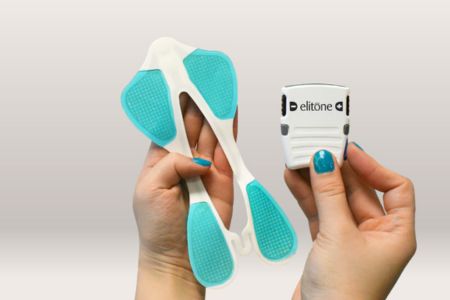
Elitone uses a flexible GelPad placed externally against the perineal area, where a conventional bladder-leak pad would ordinarily be worn. Four conductive hydrogel regions are positioned to direct stimulation through the pelvic floor muscles and surrounding tissues. The GelPad’s shape helps make that placement repeatable from one treatment session to the next.
The conductive hydrogel also performs two important functions: it holds the electrode against the skin and creates a low-impedance connection through which the stimulation can be delivered. Distributing the current across multiple conductive regions helps provide more even stimulation than would be expected from very small, concentrated electrodes.
How Stimulation Reaches the Pelvic Floor
The skin and tissue between a surface electrode and the pelvic floor create electrical resistance, also called impedance. This has historically been one of the challenges of external pelvic floor stimulation: simply increasing the output of a conventional electrical signal can increase sensation at the skin before sufficient stimulation reaches the intended muscles and nerves.
Elitone addresses this challenge with its proprietary Pre-Modulated Waveform (PMW). Elitone’s PMW combines the therapeutic treatment signal with a high-frequency carrier signal before the stimulation reaches the electrodes. Because skin impedance decreases as electrical frequency increases, the high-frequency carrier helps the treatment signal pass through the skin and soft tissue more efficiently and comfortably.
The carrier signal itself is not the therapeutic treatment frequency. Instead, it acts as a delivery mechanism for the lower-frequency modulation that is intended to produce the desired muscle or nerve response.
This distinction helps explain why modern transcutaneous pelvic floor stimulation can differ substantially from a conventional surface electrical stimulator. Effective treatment depends not only on intensity, but on the waveform, carrier signal, electrode geometry, anatomical placement and therapeutic stimulation pattern working together.
A balanced, symmetric waveform can also help limit net direct-current buildup at the skin-electrode interface, an important consideration for comfort during repeated treatments.
No single electrical specification determines whether a stimulation device will work. Effective transcutaneous stimulation depends on several parameters operating together.
- Therapeutic frequency: The number of treatment pulses delivered each second, measured in hertz (Hz). Different frequencies can produce different muscle or nerve responses.
- Carrier signal: Elitone’s PMW incorporates a high-frequency carrier to help carry the therapeutic modulation through the skin and intervening tissue. Higher-frequency stimulation encounters lower skin impedance, which can improve transcutaneous delivery and comfort.
- Waveform: A balanced, symmetric waveform can help support comfortable repeated transcutaneous treatment.
- Amplitude or intensity: The strength of the stimulation. Increasing intensity recruits additional excitable nerve fibers until an effective but comfortable treatment level is reached.
- Duty cycle: The programmed relationship between stimulation and rest. Rest periods allow the pelvic floor to relax and help reduce muscle fatigue.
- Electrode geometry and placement: Electrode size, spacing and location influence how current is distributed and which tissues are stimulated.
Two devices can both be described as “electrical stimulators” while delivering substantially different treatments. Frequency alone also does not describe the complete signal. The waveform, amplitude, phase duration, treatment timing and anatomical placement must be considered together. This is why comparing devices simply by calling them TENS or EMS units can obscure important differences in how their stimulation is actually delivered.
Electrical Stimulation for Stress vs. Urge Incontinence
Stress and urge incontinence involve different bladder-control problems, so Elitone and Elitone Urge use different stimulation programs.