Intermittent Catheterization
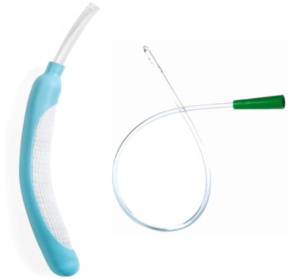
Intermittent catheterization involves inserting a catheter long enough to empty the bladder and then removing it.
For some women with chronic urinary retention or neurological bladder dysfunction, this may be done several times per day.
Many women can learn clean intermittent self-catheterization and perform it independently at home.
Advantages can include:
- No tube remaining in place between catheterizations
- Greater mobility and independence
- Lower risk of some complications compared with a continuously indwelling catheter
The schedule depends on bladder capacity, fluid intake, residual urine volume, and the underlying condition.
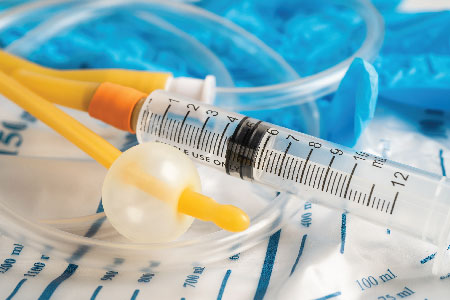
Indwelling or Foley Catheter
An indwelling catheter, commonly called a Foley catheter, remains inside the bladder.
A small balloon near the end of the catheter is inflated after insertion to keep the tube from sliding out. Urine drains continuously through tubing into a collection bag.
Indwelling catheters are commonly used:
- During and after some surgeries
- When urine output must be measured accurately
- For significant urinary retention
- When bladder drainage is required continuously
The longer an indwelling catheter remains in place, the greater the risk of catheter-associated urinary tract infection and other complications. For that reason, healthcare teams generally try to remove indwelling catheters as soon as they are no longer medically necessary.
Suprapubic Catheter
A suprapubic catheter drains the bladder through a small opening created in the lower abdomen rather than through the urethra.
This type of catheter may be considered when long-term bladder drainage is necessary or when using the urethra is difficult or undesirable.
Potential advantages for some patients include less urethral irritation and easier management during long-term use, although suprapubic catheterization requires a medical procedure and has its own risks.
Catheters vs. Urinary Incontinence Treatment
Catheters and incontinence treatments solve very different problems.
A catheter helps when the bladder cannot empty normally.
Urinary incontinence treatments are intended to improve unwanted leakage when the bladder is otherwise able to empty.
For example:
- Stress urinary incontinence: leakage occurs with coughing, sneezing, laughing, lifting, or exercise because bladder and urethral support is inadequate.
- Urgency urinary incontinence: leakage follows a sudden, difficult-to-control need to urinate.
- Urinary retention: urine remains in the bladder because emptying is incomplete or impossible.
These conditions can occasionally occur together, but catheterization is not generally a treatment for stress or urgency incontinence.
In fact, if someone has difficulty emptying the bladder, that problem should be evaluated before assuming pelvic floor strengthening is appropriate.
Risks and Complications of Catheter Use
Catheters are widely used and can be medically necessary, but they are not risk-free.
Possible complications include:
- Urinary tract infection
- Urethral irritation or injury
- Bladder spasms
- Leakage around the catheter
- Catheter blockage
- Blood in the urine
- Bladder stones with some long-term catheter use
- Skin irritation from tubing, moisture, or collection devices
The risk depends partly on the catheter type, duration of use, underlying health conditions, and catheter-care practices.
Reducing the Risk of Catheter-Associated UTI
Catheter-associated urinary tract infection, or CAUTI, is one of the most important risks of indwelling catheter use.
Basic prevention principles include:
- Use a catheter only when medically necessary
- Remove an indwelling catheter as soon as it is no longer needed
- Keep the drainage system closed unless there is a medical reason to disconnect it
- Keep the collection bag below the level of the bladder
- Avoid kinks or obstruction in the tubing
- Wash hands before and after handling catheter equipment
- Follow the catheter-care instructions provided by the healthcare team
Routine catheter care does not generally require aggressive antiseptic cleaning around the urethra. Normal hygiene is usually sufficient unless a healthcare professional provides different instructions.
Living With a Catheter
A catheter does not necessarily prevent normal daily activities.
Depending on the reason for catheterization and the type being used, many people can walk, work, sleep, and participate in everyday activities with appropriate management.
Practical considerations may include:
- Securing the tubing so it does not pull
- Keeping the drainage bag positioned correctly
- Emptying the collection bag as instructed
- Watching for changes in urine flow
- Maintaining normal hydration unless fluid restriction has been prescribed
- Following instructions for bathing, exercise, and sexual activity
Women performing intermittent self-catheterization may need time to become comfortable with the technique, but many are able to incorporate it into a normal daily routine.
When to Contact a Healthcare Professional
Contact your healthcare professional if you have a catheter and experience:
- Fever or chills
- New or worsening pelvic, abdominal, back, or side pain
- Cloudy or foul-smelling urine accompanied by other symptoms
- Significant blood in the urine
- Little or no urine draining despite feeling that the bladder is full
- A catheter that falls out
- Persistent leakage around the catheter
- Increasing redness, swelling, drainage, or pain around a suprapubic catheter site
Do not remove or replace an indwelling catheter yourself unless you have specifically been trained and instructed to do so.
Where Elitone Fits
Elitone is not a substitute for a catheter when someone cannot empty the bladder normally.
In fact, urinary retention and significant difficulty emptying the bladder require medical evaluation, and pelvic floor strengthening is not appropriate for every bladder-emptying problem.
Elitone is designed for a different situation: women whose bladder empties normally but who experience urinary leakage because pelvic floor and urethral support are inadequate.
For stress urinary incontinence, Elitone uses external neuromuscular electrical stimulation to produce repeated pelvic floor contractions and strengthen the muscles responsible for bladder support.
So while a catheter provides a way to drain urine when the bladder cannot empty, Elitone helps improve continence when the problem is unwanted leakage.
Knowing which problem you have — difficulty holding urine, difficulty emptying urine, or sometimes both — is essential before choosing the appropriate treatment.